
Discord vs. Telegram for Agentic Work: Three Setups, One Verdict
Three setups, one verdict: Discord won as my agent home — not because it's easier to set up, but because threads contain projects while channels scatter them. Telegram still wins on raw message length, and the file-baton pattern is the fix that doesn't require switching.
I’ve set up my agent home three times: twice on Discord, once on Telegram. Discord is where it ended up. Not because it’s easier. It isn’t.
The setup advice everyone repeats is “use Telegram, it’s the easiest” — and it is. BotFather hands you a token in five minutes and you’re talking to an agent. Discord wants a developer portal, a bot application, privileged intents, an OAuth invite, and a server you control. Telegram wins setup by a mile, and that advice is still wrong for agentic work. Here’s what actually happened across three setups, and the one thing Telegram still does that Discord can’t.
The default
The first time, I set up my agent on Discord because that’s what everyone seemed to do. I didn’t really know what I was doing — one server, one channel, and I chatted with my agent like it was a single long ChatGPT window. No structure, no workflows, no projects. Just one scrolling wall of conversation. It worked, and I got almost nothing out of it, because I hadn’t built anything around it yet. The platform wasn’t the problem. I wasn’t using the platform.
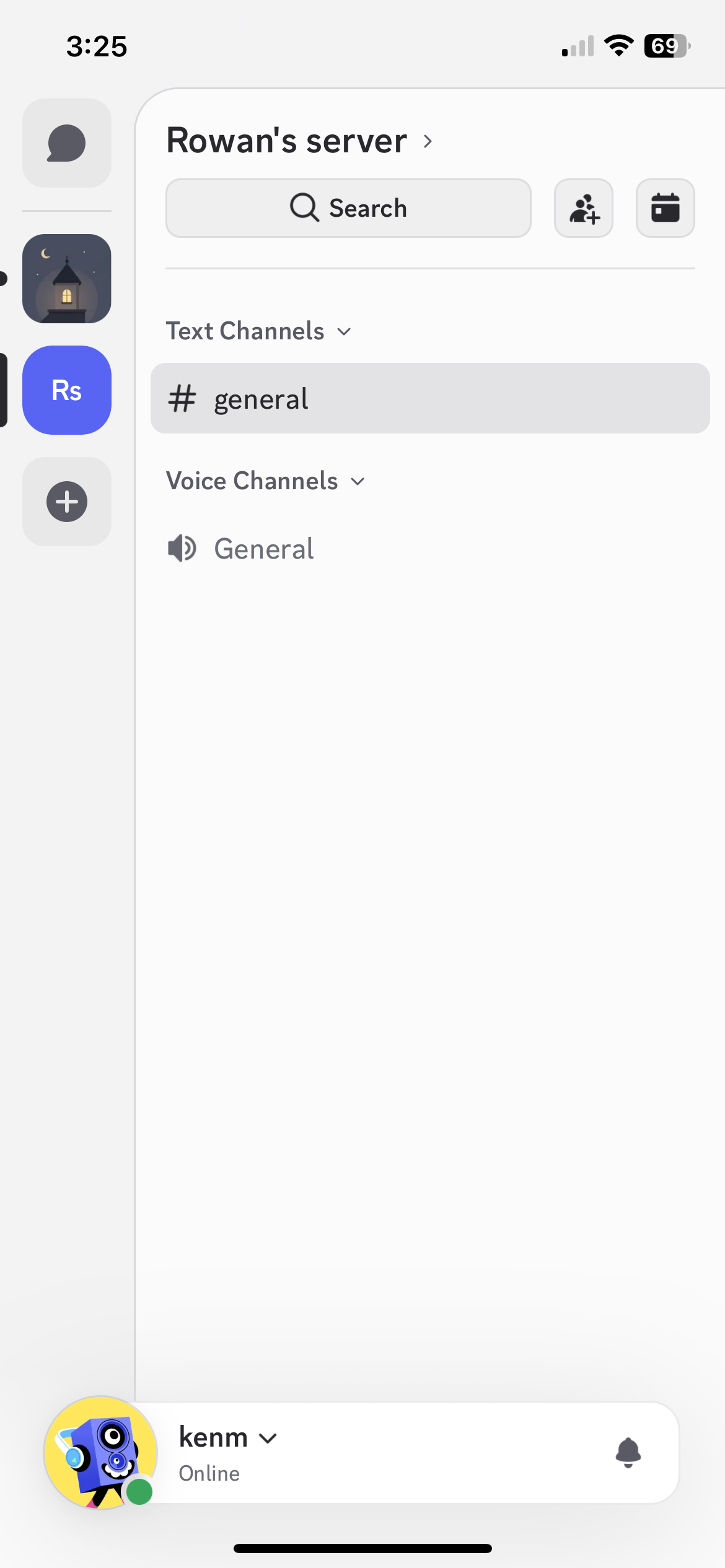
The first home, in one image: a server with a single #general channel. One long ChatGPT window, nothing built around it.
The “easiest” option
Second machine, fresh start. The de facto path for a new agent setup was Telegram. The claim was right: create a bot with @BotFather, paste the token, done. It was fast, and it felt good on mobile.
I’d learned one thing by then: multiple channels beat one. So I made four, each mapped to a workflow — this channel is for dictations, this one for research, this one for writing. The idea was “a workflow gets a channel, and you keep triggering that workflow in its channel.” The dictation channel clicked immediately — that flow is still one of my favorites. The other three never did. They just sat there.
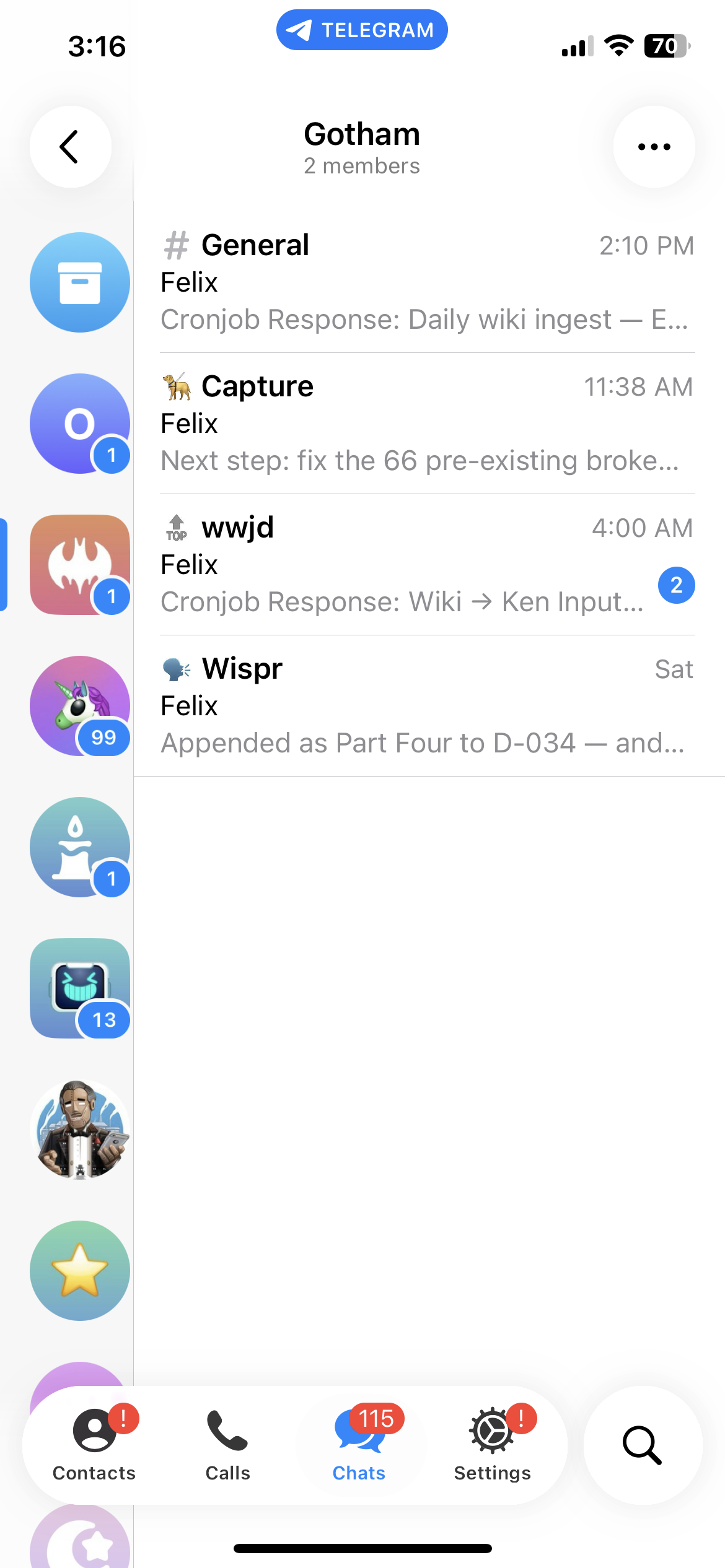
The four workflow channels — General, Capture, wwjd, Wispr. One clicked; the rest sat there.
If you’re choosing where to run yours, five emails cover the setup tradeoffs.
The clutter failure
Then the real problem showed up. My general channel would be mid-turn — my agent churning on something, me waiting on output — and I’d want to do something else in parallel. So I’d grab one of those unused workflow channels and use it for whatever I was actually doing, which was almost never the workflow it was named for.
That’s how the messages got strewn everywhere. Project A’s context lived in four channels, none of them the one project A belonged to. The organization I’d built had inverted on me: channels designed for specific workflows were carrying random project traffic, and the projects themselves had no home. I was working around my own system every single day. That’s the failure mode nobody warns you about — not “Telegram is hard to set up,” but “your work stops fitting the shape you gave it.”
The deliberate rebuild
Third machine, and I’d had enough of the re-setup ritual. The question was where to put the new agent. Telegram worked. But I’d lived in Discord before, I knew what it could do, and I went back — even knowing the setup would hurt. It did: developer portal, intents, invite link, the whole dance. Worth it.
The difference is threads. Instead of a channel per workflow, I have a channel per area and a thread per project. Multi-day work lives in its own thread, stays open while I’m working on it, and I can pop back and forth without losing the thread — literally and figuratively. Projects that used to span four channels and a week of “where did I put that?” now live in one place for their whole life. The thing I was missing wasn’t more organization. It was organization at the right unit: the project, not the workflow.
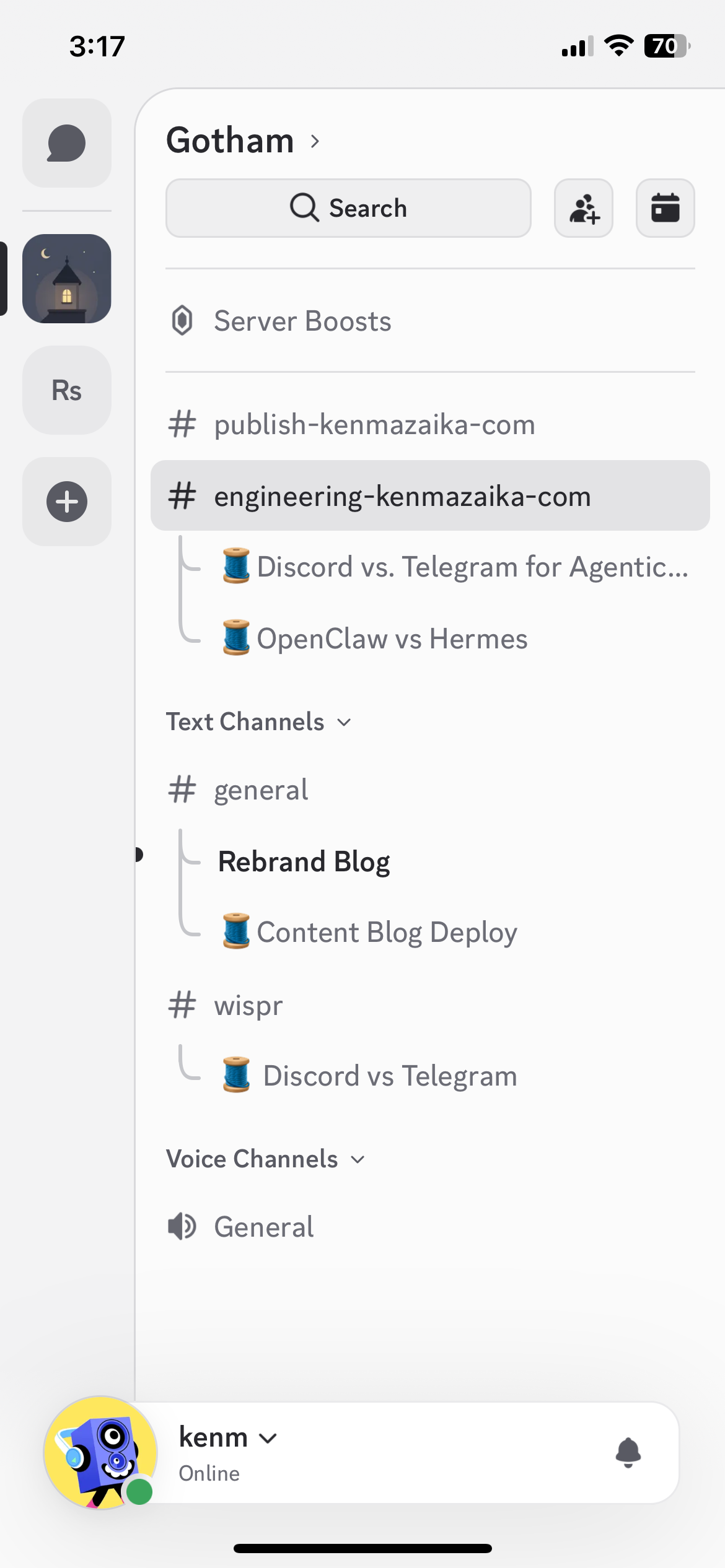
Same server, later era: threads nested under channels, one per project.
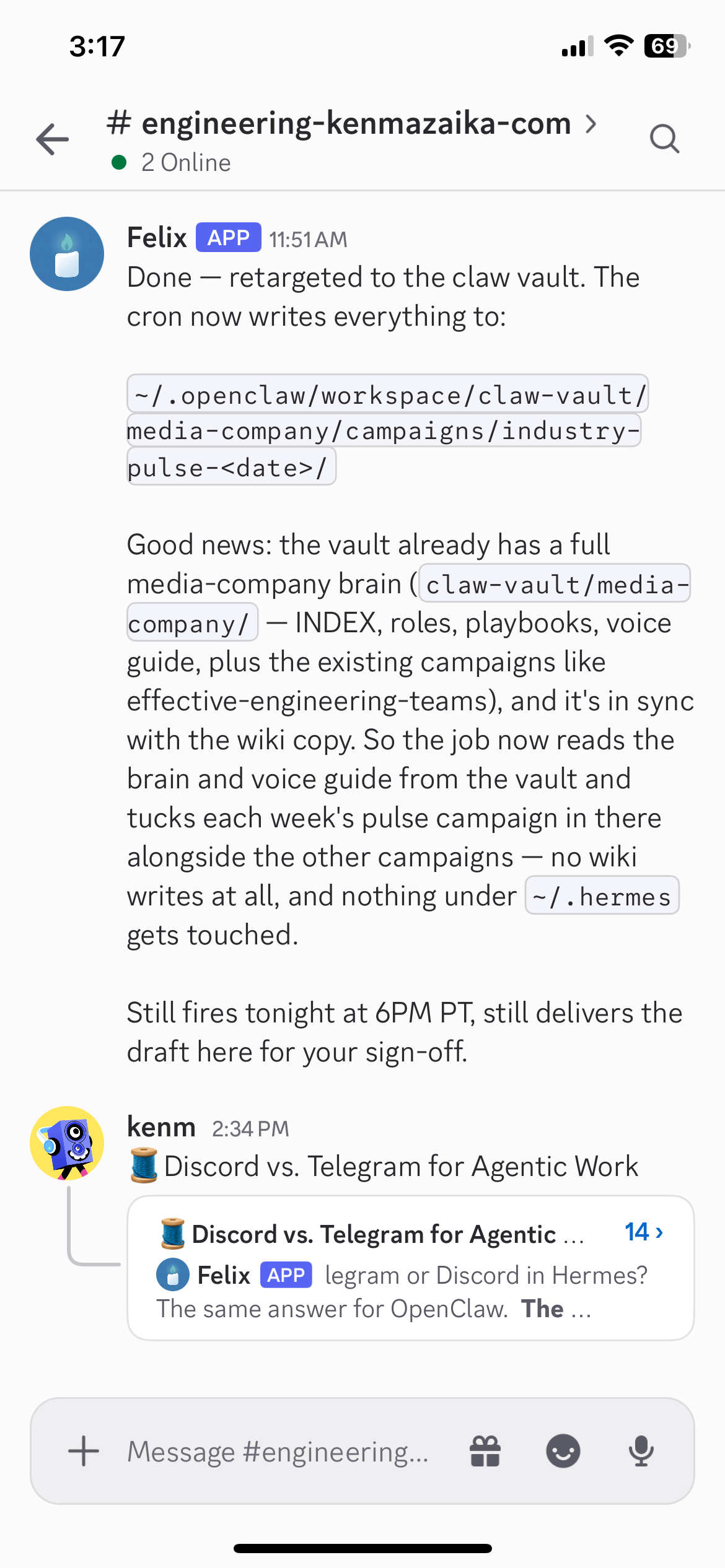
A project thread as a first-class container — and the preview text is this very draft, which is the point made visible.
The one thing Telegram still wins: message length
Now the honest part. There’s exactly one place Telegram beats Discord, and I hit it within an hour of switching: message length.
Discord’s per-message limit is 2,000 characters — 4,000 if you pay for Nitro ($3 or $10 a month). Telegram’s is 4,096, and the client handles long pastes by splitting them into multiple messages automatically.
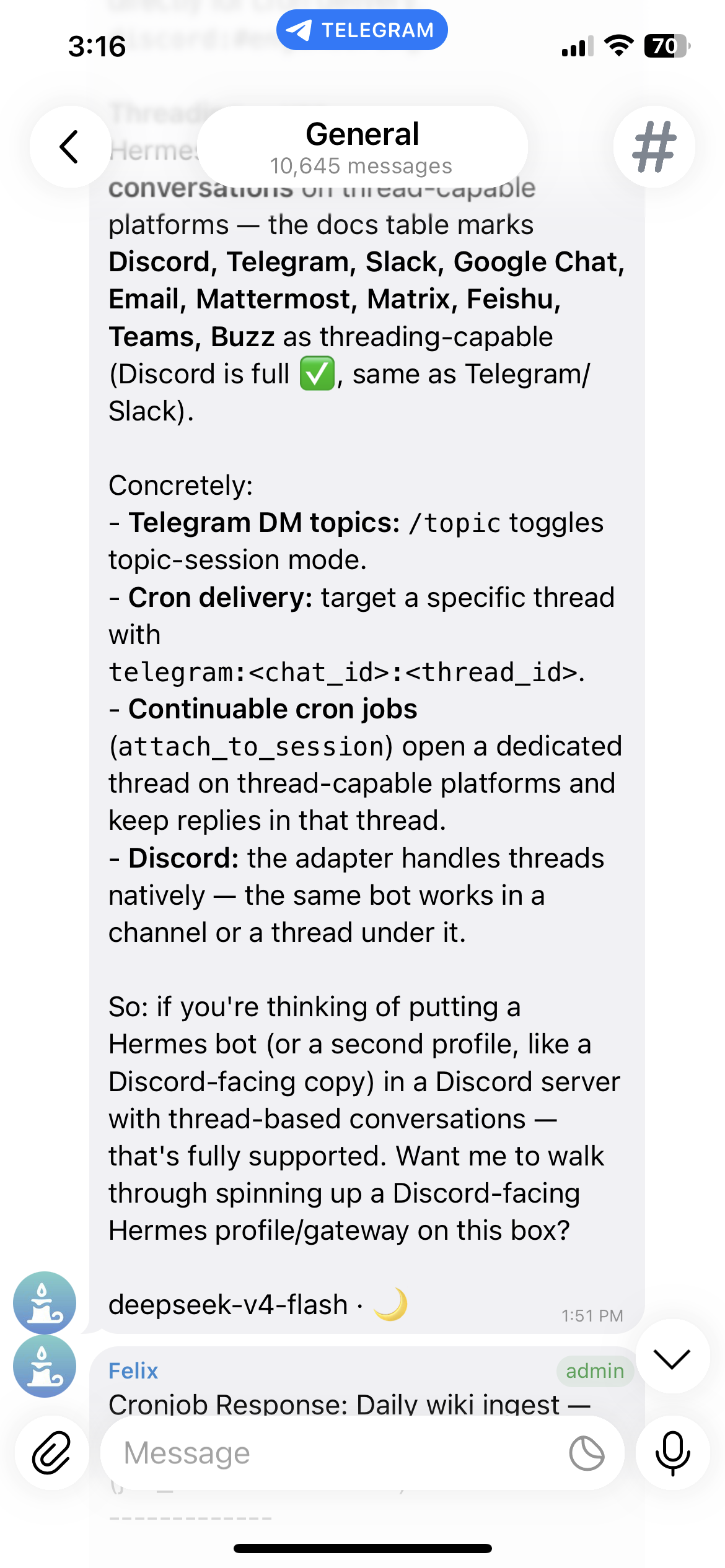
Telegram just shows the whole message. No split, no error — the contrast that makes the length gap real.
My dictations routinely run past 4,000 characters. The first long one I dictated after switching to Discord died at 2,000 — mid-sentence, about the very limit I was complaining about. Nitro’s 4,000 wouldn’t have saved it either; my dictations were already over that. The math doesn’t work: the upgrade doesn’t get you to the size you need.
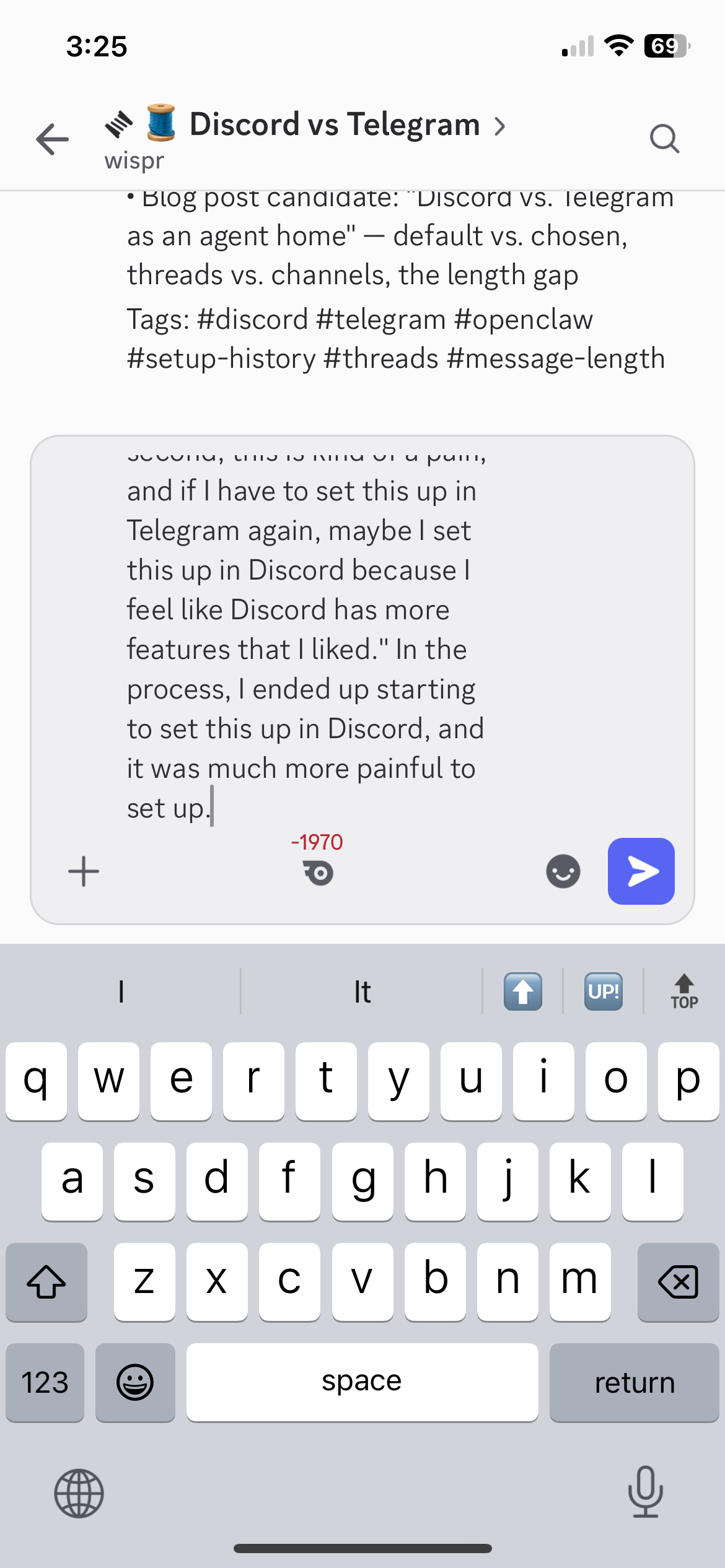
The draft, 1,970 characters over the limit, red counter and all — caught mid-dictation about the limit itself.
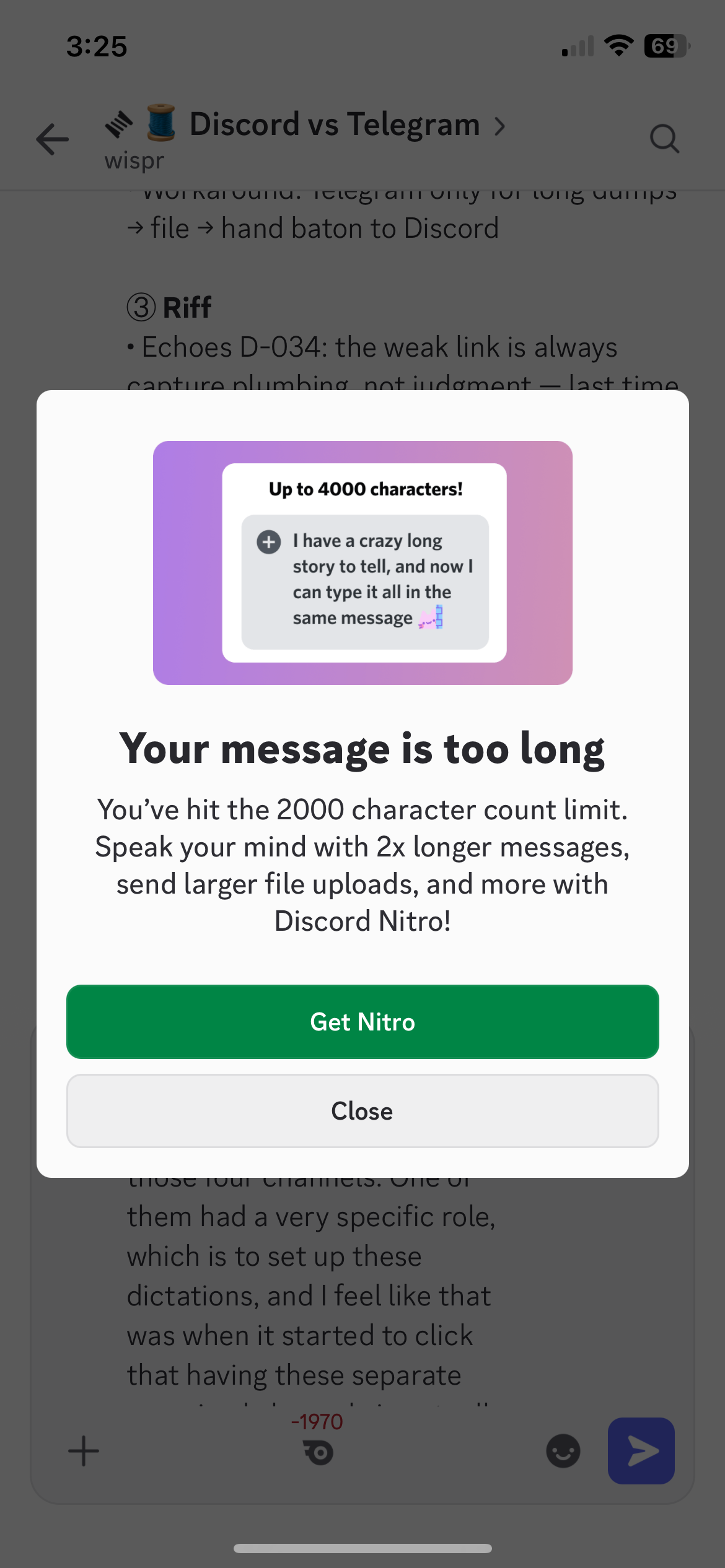
And the platform’s answer: pay for Nitro to get 4,000. The upsell that wouldn’t have fit the message anyway.
The workaround: the file-baton pattern
The fix isn’t a bigger limit — it’s a file. When content is longer than a message, it stops being a message. Write it to a file, hand the file to the thread, and the thread holds the pointer while the file holds the content.
That’s the pattern I run now: long dictations and docs go to a file, the file lands in the project thread, and the agent picks it up from there. Nothing truncates, nothing splits, and it works on any platform — no Nitro, no workaround plugins, no waiting for Discord to raise a limit it shows no sign of raising. Telegram’s 4,096 is better than Discord’s 2,000, but both are ceilings; the file is no ceiling at all. I keep Telegram installed purely as a long-capture sidecar for the rare case where I want to dump text fast and hand it off. Discord is the home; Telegram is the loading dock.
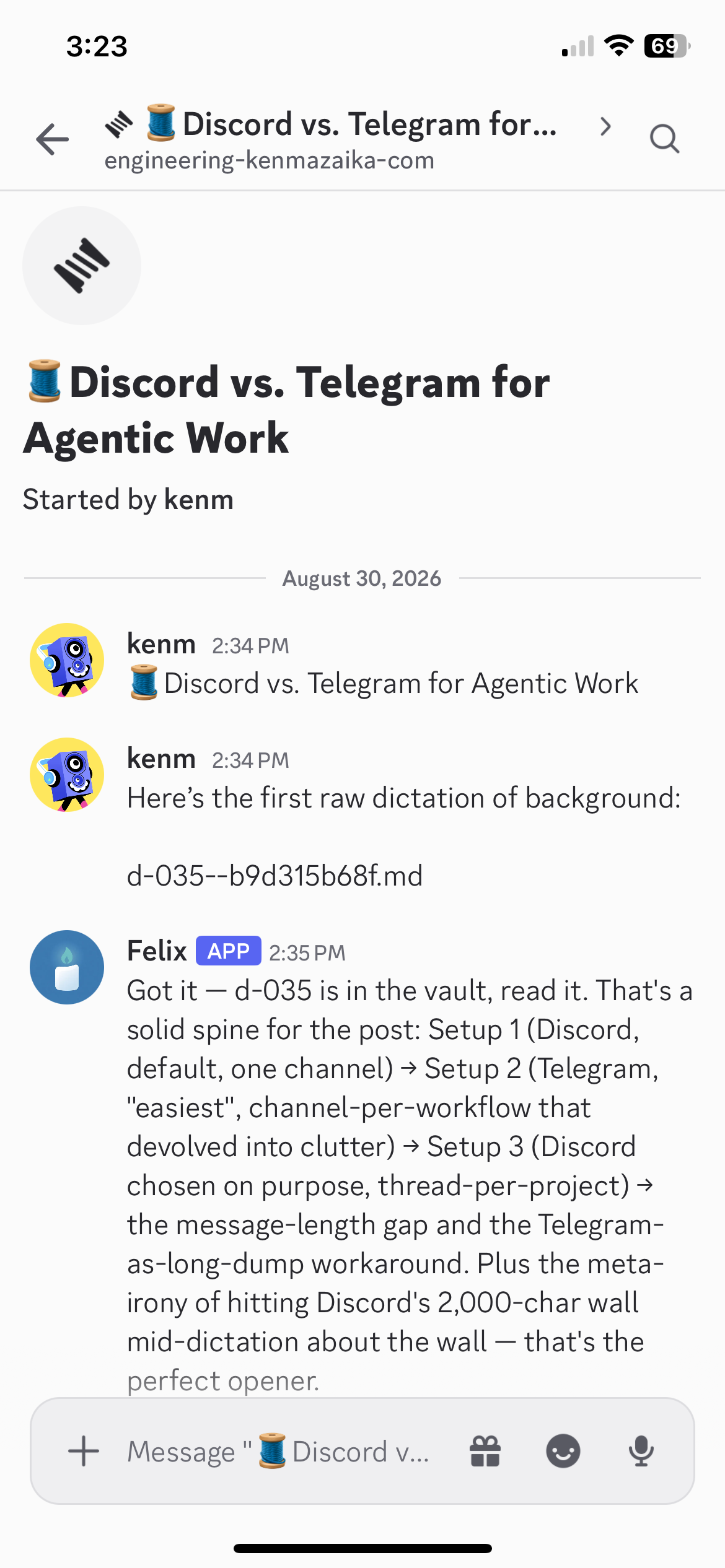
The pattern, receipted: the raw dictation file dropped into the project thread, the agent picking it up from there. Content longer than a message becomes a file.
Telegram or Discord in Hermes? The same answer for OpenClaw.
The question I keep getting asked — and the one I’d have wanted answered — is whether this changes if you run Hermes instead of OpenClaw. It doesn’t. Both are agentic platforms; both connect to Telegram and Discord as delivery surfaces, and the agent brain — memory, skills, tools — is identical either way. The platform is the surface you talk through, not the agent itself. (For the harness-level comparison with receipts, see Hermes vs OpenClaw.)
That’s the part that generalizes: threads vs. channels is a property of Discord and Telegram, not of the agent software. Whatever agent platform you run, the same three setups play out the same way. Pick the surface by how your work is shaped — and if your work is multi-day projects, that’s threads.
One honest bound. This is my experience across three setups, not a controlled study, and Telegram has real trust baggage right now — it was pulled from the App Store for a few hours in August 2026 over a CSAM report, and its founder has been fighting legal battles on two continents since 2024. Those are context, not the argument. The argument is organizational: threads contain projects, channels scatter them, and the length gap has a file-shaped hole in it.
Set up once, learn it twice, choose it on purpose the third time. Discord is my agent home. For the long stuff, there’s a file for that.